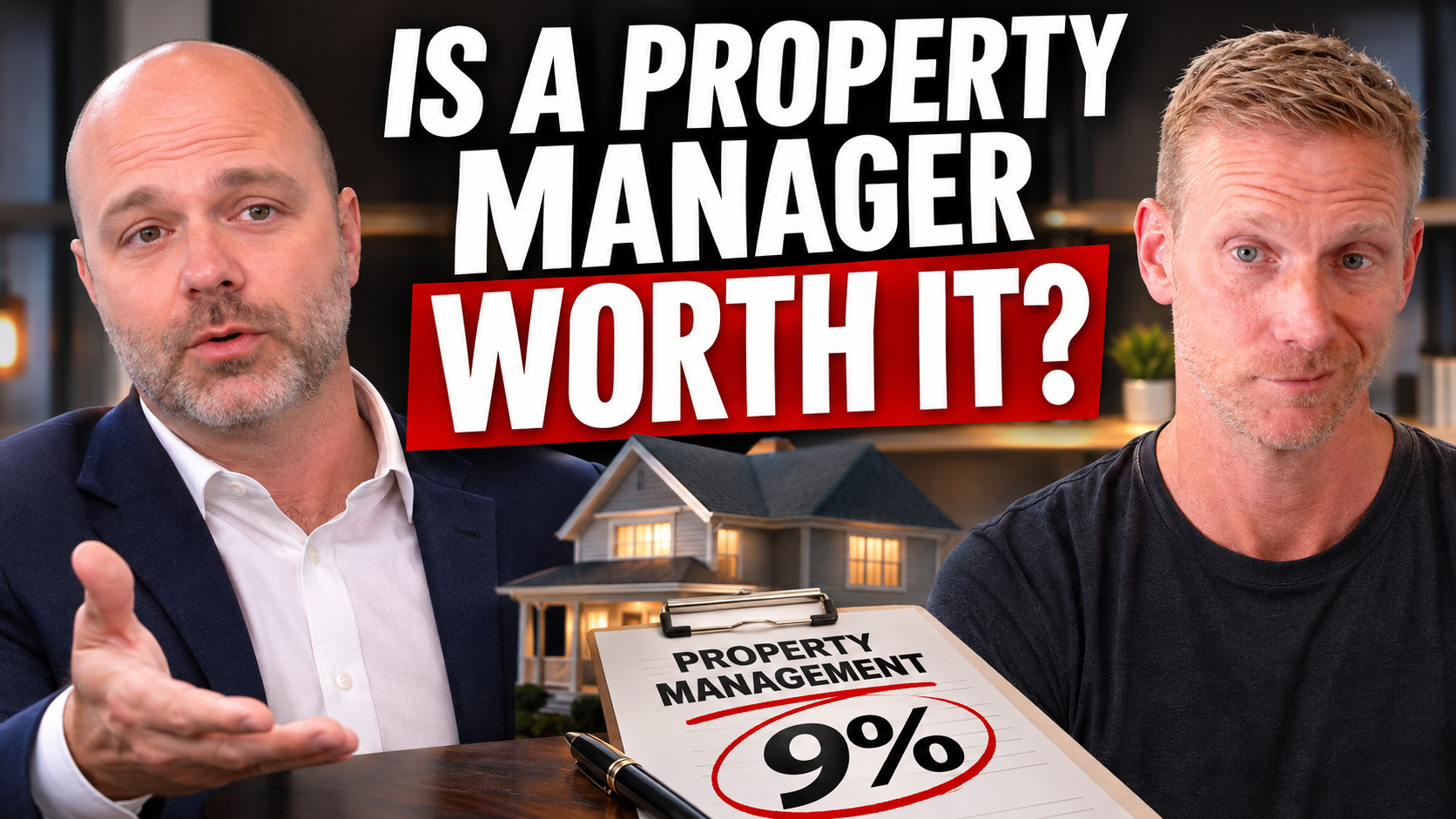
Why pay a property manager at all? It's a fair question, and any owner turning a home into a rental should ask it. In this video, Red Door's Chris Knight and Michael Taylor walk through when self-managing makes sense, when it doesn't, and how to judge whether a specific manager is worth the fee.
Their short answer: it depends on what systems you already have in place and what your time is worth. Here are the questions they suggest working through.
Do You Have a Leasing and Screening System?
Showing the property is the easy part. The harder question is what happens next. When someone is interested, where do you send them to apply? What background check will you run? What are your written criteria?
Michael put the questions plainly:
- Do you accept a 500 credit score?
- Do you accept bankruptcies?
- Do you accept prior evictions?
If the honest answer is that you'll decide based on whether the applicant seemed nice, you don't have a system. Chris described meeting an owner who had managed a duplex in Irvington for years without screening software. His main qualifying tool was the car the applicant drove to the showing. That is not a way to qualify a tenant. As Michael pointed out, whether they're current on the car payment would tell you more.
A consistent, written screening process protects you and treats every applicant the same way. If you don't have one and don't plan to build one, that is a strong sign a manager is worth considering.
Do You Have Reliable Contractors?
This was the deciding factor in the same Irvington conversation. The owner asked Chris whether he could self-manage. Chris asked whether he had contractors and vendors he trusted. He did: a team he'd worked with for many years.
Chris told him directly that he could self-manage. Handing the property over would mostly bring frustration and cost him roughly 9 percent a month for work he was already capable of doing with a process that already worked.
Maintenance carries this much weight because, as Michael explained, it can make or break a rental:
- Cost: maintenance spending can make or break your return on investment.
- Retention: slow or poor maintenance is the number one reason tenants leave.
- Turnover: when tenants leave, you take on turnover costs and vacancy costs.
Without vetted contractors, you end up with vendors who don't show up on time and tenants who are frustrated as a result. A verified group of contractors may be the single most important thing to have in place before you self-manage.
Can You Prepare, Price and Market the Property?
Chris asked another question owners should take seriously: do you have the eye to tell what the property needs and what "market ready" looks like?
He recently saw a listing with three photos: a crooked shot of the exterior, one of the living room and one of the toilet. That was the whole listing. You won't attract quality applicants that way.
Self-managing means handling property preparation, pricing, photography, advertising, inquiries and showings. Each one affects how fast the home leases and who applies.
Can You Treat It as a Business?
Michael's advice was to look at the rental as if it isn't your house. Look at the photos and ask honestly whether they're good enough. Why is there a picture of a toilet?
This is hardest when the rental is your former home. Many owners carry emotional attachment to a house they lived in, and that can make it a poor time to self-manage. The decisions have to be business decisions. If a tenant is late on rent, the business response is to charge the late fee, serve a notice, try to work something out, and if rent still isn't paid, file for eviction promptly.
If you know you'll struggle to enforce the lease on a property you're attached to, factor that into the decision.
Do You Plan to Scale?
Red Door manages for many owners with a single rental and many with two, three, five or ten. Michael's view is that past a certain point you can't do it alone. You either hire someone or self-management becomes at least a part-time job.
By two or three rentals it can already be taxing. Three vacancies coming up at the same time is a lot to juggle alongside a full-time job.
Weighing the Cost
The industry average for property management is roughly 8 to 10 percent of monthly rent, usually with a leasing fee on top. Is that worth your time?
Michael's framing is to estimate how many hours managing your one, two or four homes will take, and decide whether you're willing to pay someone for those hours. If you can handle it in a reasonable amount of time and don't want to pay for it, self-managing is a legitimate choice, and there are systems available to help.
If your time is already committed elsewhere, $100 or $200 a month may be a reasonable price to buy back time and some peace of mind while you keep the gains from the investment.
How to Judge Whether a Manager Is Worth It
If you decide to hire, Chris recommends asking specific questions before you sign.
Communication
How will they communicate, and how often? Look for predictable, useful updates.
Pricing
How will they price the property, and how much experience do they have? A rental analysis pulls comparable rentals in the area, and those comps can vary a great deal. Experience matters in reading them correctly.
Screening
How do they screen applicants? You're looking for a clear, consistent process. At Red Door, process comes up constantly for this reason.
Maintenance Approvals
Do they have a maintenance approval limit, such as $500? A set limit lets the manager act on repairs quickly without waiting on approval for every item, which directly affects tenant retention.
Invoice Review
Do they review invoices, or just pay whatever is submitted and post it to your owner ledger? A good manager has the team and process to check whether an invoice is accurate and whether the work falls under a warranty.
The Core Question
Chris summed it up with one question: do you want to do the job of a landlord, or do you primarily want to own a rental property?
If you have screening criteria, trusted contractors, a clear eye for presentation and the discipline to treat the property as a business, self-managing can work well. If you're missing some of those, or you plan to grow, a manager with strong processes can protect both your time and your return. If you're weighing that decision for a rental in the metro, you can learn more about Red Door's Indianapolis property management services.
Frequently Asked Questions
How much does a property manager typically cost?
Michael Taylor puts the industry average at roughly 8 to 10 percent of monthly rent, usually with a separate leasing fee on top. For many owners that works out to around $100 to $200 a month.
When does it make sense to self-manage a rental?
Self-managing can work if you have a written screening process, a reliable team of contractors you've used for years, and the ability to treat the property as a business. Chris Knight told one duplex owner with exactly that setup that he didn't need a manager.
Why do contractors matter so much when deciding whether to self-manage?
Maintenance can make or break your return on investment, and poor maintenance is the number one reason tenants leave. Without vetted vendors who show up on time, you face frustrated tenants plus turnover and vacancy costs.
How many rentals can an owner realistically self-manage?
By two or three rentals it can become taxing, especially if several vacancies land at once. Beyond that, you either hire a manager or treat self-management as at least a part-time job.
What should I ask a property manager before hiring one?
Ask how and how often they communicate, how they price properties, how they screen applicants, whether they have a maintenance approval limit such as $500, and whether they review invoices for accuracy and warranty coverage before paying them.
Video Transcript
Chris Knight: Why pay a property manager? Let's start it off. Is that a fair question?
Michael Taylor: 100%, it's a fair question. You absolutely need to be asking yourself that if you decide to turn your home into a rental.
You've got to have some systems in place. Okay, so you show the property, somebody's interested, now what? Where are you going to send them to get an application? What kind of background check are you going to do? What kind of criteria do you have? Do you accept a 500 credit score? Do you accept bankruptcies? Do you accept evictions? Are you just kind of doing this willy-nilly because you thought they felt like a nice person?
Chris Knight: And I still have these conversations. I met with somebody not all that long ago. They've managed this property in Irvington for so long. It's a duplex. When they were meeting strangers, they didn't believe in the software. Their most qualifying tool was what car did they pull up to the home in? Have you heard that before?
Michael Taylor: No, that's a good one. That's a good one.
Chris Knight: I'm shocked. I'm shocked, because I've heard so many private landlords use that as their qualifying tool. What did they pull up in? Obviously, if you don't know, that is not the proper way to qualify your tenant.
Michael Taylor: Should be, are they current on their car payments? That would maybe be a better resource.
Chris Knight: Bingo. Absolutely. Exactly.
This was an individual, and we went through his personal circumstances, and he was kind of asking me for my opinion on whether he could self-manage or whether he needed a property manager.
Do you have contractors? Do you have vendors? Do you have people? Because if you don't, you get into the situation I was just talking about a minute ago. The people won't show up on time, so your tenant's pissed off because they didn't show up.
He did. He had a contractor team that he had worked with for many years. I straight up told him, "Look, I think you can self-manage. I think you're good. I think you're only going to find frustration when you turn that over to me, and you're missing out on your 9% per month, because we're doing the things that you already are capable of doing." He already had a streamlined process. So that was it. Do they have reliable contractors? He did. Thoughts on that, Mike?
Michael Taylor: Yes, having contractors is a huge portion, because as we know, maintenance can make or break your rental, and the cost of maintenance can make or break your return on investment. So having a verified, vetted bevy of contractors is so key to maintaining a successful rental. Absolutely, one hundred percent.
Chris Knight: And does that factor into your tenant retention?
Michael Taylor: A hundred percent. It's the number one reason why tenants leave. And then you have turnover costs and vacancy costs and all of that kind of stuff. So it's maybe the number one thing in terms of having it in place.
Chris Knight: Do you have the eye to determine what the property needs? What is market ready? So property preparation, pricing.
I looked at one not all that long ago. All they had was this crooked photo of the exterior, one photo of the living room, and then one photo of the toilet. It was just the toilet. That's all it was, and they had the property up for rent. It's crazy. So the photography, right? You can't do that. You're not going to find quality applicants when you have a picture of your toilet that you're trying to market your property with. So advertising, inquiries, the showing aspect.
Michael Taylor: Be professional, and also be independent. Be able to look at your house like it's not your house, look at those pictures and go, "Wow, those pictures freaking suck." Why do I have a picture of a toilet? Be honest with yourself, be independent, and not have so much emotional baggage. If it's your personal house and you lived there before, a lot of people have a lot of emotional baggage that comes along with that. So that may not be the best time to self-manage, when it's your personal house.
You've got to be able to be professional about it, not get emotionally involved. Maybe the number one thing is to be able to be a little bit removed and think of it as a business decision instead of, "My personal home," or, "This is a personal decision for me." No, this is a business decision. If somebody is late on rent, the business decision is to charge them a late fee, give them a notice, try to work something out with them, but then ultimately you've got to evict them, early and often, if they're not paying rent.
Is it valuable enough to you to pay whatever your property manager is going to charge you? Industry average is what, eight to ten percent, something like that. You've got a leasing fee on top of that. So is that worth your time? There's a lot that goes into it, especially when you're doing it yourself.
If you intend on scaling or adding more than one rental... We have lots of owners who just have one rental, but we also have lots of owners who have two, three, four, five, six, ten rentals. If you want to get to that level, there's no way you can do it on your own. You either have to hire somebody, or it has to be at least a part-time job for you. By the time you get to, honestly, two or three, it can be really taxing at times. If you have three vacancies coming up, it's a lot to juggle.
Chris Knight: Two things absolutely come to mind, and this is absolutely going to depend on whether this individual is worth it or not. How will you communicate? How often will you communicate? You want to look for predictable, useful updates.
How are they going to price the property? How much experience do they have? Because I find when I'm sending out a rental analysis, that experience absolutely does matter, because that rental analysis that is pulling comps in the area can vary a great deal.
How do you screen applicants? You're looking for a clear, consistent process. That's huge with Red Door. You hear us talk about it all the time. Processes, processes, processes.
How do you handle maintenance approvals? Now, this is a sensitive one. Do they have a $500 maintenance limit, which is important that they do? I'm not going to go into the defense of that right now, but it's absolutely important that they have some type of maintenance limit so that they can action items quickly. This will absolutely affect your tenant retention.
Are they going to review invoices? Or if an invoice is sent, are they just going to submit payment and then throw it on an owner ledger? They need to have the team in place and the processes in place to evaluate that invoice. Is it accurate, number one? And then any kind of warranty or anything else like that.
So these are just a connection between evaluating, number one, is it worth it? And then how to evaluate whether the actual property manager is worth it.
So to close this all out, let me ask: do you want to do the job of a landlord, or do you primarily want to own a rental property? Mike, bring us home. Close it out.
Michael Taylor: Well, the question here is, is a property manager worth it? And I think everybody has to answer that for themselves. What is your time worth? We can kind of defend our fees. I think it's pretty easy to do, and I think we've talked about that here. But what is your time worth to you? How much time do you think that you're going to have to spend to manage these one, two, three, four homes that you have?
If you think that you can do it in a certain amount of time and you're not willing to pay for those hours, then yeah, you should definitely do it yourself. There are systems out there that you can use. But if you value your time, if you've got a full-time job, it might be worth a hundred bucks or two hundred bucks a month, whatever it is, for that property manager to buy your time back and to buy a little bit of sanity.
And that's what I think a property manager does, and what a good property manager will do for you: provide you time and sanity while allowing you to continue to get the gains from the investment that you have put your hard-earned dollars into. So I think those are the questions that you've got to ask yourself.
Chris Knight: Drop a comment. Let us know. Let's talk about it. We'll catch you in the next video.