Indianapolis is still doing what investors like to see: rents are improving, homes are moving, and the sales market remains affordable compared with many stronger national markets. But there is a catch. Cheap does not always mean safe. Sometimes the lowest-priced deal is just a problem wearing a discount sticker.
Watch the Indianapolis Market Report Segment
Indianapolis Is Improving, But Vacancy Still Controls the Math
The May 2026 Indianapolis rental market showed positive movement. Average single-family rent came in at $1,791, improving both month over month and year over year. That is good news for owners who have been watching insurance, taxes, maintenance, and operating costs continue to push upward.
Average days on market landed at 45 days. That is a meaningful improvement from the higher numbers seen earlier in the year, but it is still not the 30-day range most owners would prefer during peak leasing season.
That matters because rent price is only one part of ROI. A higher rent number looks great until vacancy starts eating the extra income like it got invited to the buffet. Owners need to understand that pricing, competition, condition, and leasing speed all work together.
The Indianapolis rental market is not weak, but it is not rewarding lazy pricing either. If the property is priced too aggressively, the market will usually respond with silence. And silence, in leasing, is expensive.
Indianapolis Rental Snapshot
- Average single-family rent: $1,791
- Average days on market: 45 days
- Active single-family homes: 1,126
- Average rent per square foot: $1.10
- Apartment average rent: $1,207
- Active apartments: 1,078
- Apartment rent per square foot: $1.40
- Townhome/condo average rent: $1,695
- Townhome/condo days on market: 77
- Active townhomes/condos: 136
- Townhome/condo rent per square foot: $1.01
The Three Numbers Owners Should Watch First
The most useful rental data in this Indianapolis market update comes down to three numbers: average rent, days on market, and active inventory.
Average rent tells owners what the market may support. Days on market tells owners how quickly the market is responding. Active inventory tells owners how much competition they are facing. Together, those numbers give a cleaner picture than rent alone.
That is where some owners make the expensive mistake. They look at the rent number and ignore the rest. But a property listed too high in a competitive market does not become “premium.” It becomes stale. And once a listing sits, owners often end up losing more to vacancy than they would have gained from the higher asking rent.
That is why setting the right rent before the property sits too long matters. The goal is not to guess high and hope. The goal is to price in a way that protects rent, leasing speed, and long-term ROI.
The Sales Market Is Stable, Which Is Better Than It Sounds
On the sales side, Indianapolis remains one of the more affordable markets in the region. Using the investor lens of homes under $500,000, the average sales price came in at $257,611.
That was up roughly 2% month over month and almost flat year over year, with a 0.32% increase. In a market where other areas may be seeing price pressure, that kind of consistency is not boring. It is useful.
Average days on market for sales was 49 days. Homes sold reached 1,084, up 17% month over month and down 2% year over year. The average price per square foot was $167.
The Indianapolis sales market is not acting like a rocket ship. It is acting like a market that still gives investors a reasonable way in. For rental owners and buyers, that matters more than hype.
Indianapolis Sales Snapshot
- Investor price cap used in the report: Homes under $500,000
- Average sales price: $257,611
- Average sales days on market: 49 days
- Homes sold: 1,084
- Average price per square foot: $167
The Cheap House Trap Is Still Very Real
Indianapolis attracts investors because the entry points can look incredibly affordable. That is especially true for investors coming from markets where $257,000 barely gets you a garage with feelings.
But the segment made an important point: many new investors are still chasing the same fantasy. Buy a home under $100,000, put $20,000 into it, and rent it for $2,000 a month.
On paper, that sounds wonderful. In real life, those properties can sit in rougher areas where risk is not obvious in the spreadsheet. Vacancy, theft, squatters, eviction costs, weak tenant demand, and heavy turnover can turn a “cheap” deal into an expensive lesson.
The cheapest property is not always the best rental. Sometimes it is just the fastest route to becoming a former investor.
The smarter Indianapolis investor is usually looking for a property that can attract a better tenant profile, lease in a reasonable amount of time, and avoid constant operational problems. That may mean starting closer to the $150,000 to $175,000 range instead of chasing the absolute bottom of the market.
A Good Indianapolis Deal Needs More Than a Low Price
The real Indianapolis opportunity is not just affordability. It is the ability to balance cash flow, tenant quality, appreciation potential, and manageable risk.
There are still plenty of homes under $250,000, and the segment pointed to that range as a strong investor target. But buyers still need to understand the block, the property condition, the rent potential, and the tenant demand before assuming the numbers will work.
This is where turning market interest into qualified showings and applications becomes more important than a spreadsheet projection. A property is not a successful rental because it theoretically rents. It becomes a successful rental when the right tenant actually signs, pays, stays, and takes care of the home.
And once an applicant appears, owners still need discipline. A fast lease with the wrong tenant is not a win. It is just a delayed maintenance bill, collection issue, or eviction headache pretending to be progress. Protecting the property with a stronger approval process is what keeps affordability from turning into avoidable risk.
Final Takeaway
The Indianapolis May 2026 market report gives investors a practical message. Rents are improving. Days on market are coming down. Inventory is stable. Sales prices remain affordable. The market is still giving investors a real opportunity.
But Indianapolis is not a market where owners can ignore fundamentals. Pricing still matters. Vacancy still matters. Tenant quality still matters. Neighborhood selection still matters.
Indianapolis can be a strong investor market, but it is not a shortcut around due diligence. The investors who win here are not just the ones who buy cheap. They are the ones who buy smart, price correctly, screen carefully, and manage the property like the numbers actually matter.
FAQ: Indianapolis May 2026 Market Report
What was the average rent in Indianapolis in May 2026?
The average single-family rental price in Indianapolis was $1,791, improving both month over month and year over year.
How fast are Indianapolis rental homes leasing?
Average days on market was 45 days. That was a strong improvement from earlier in the year, though still higher than the roughly 30-day range preferred during peak leasing season.
How many active rental homes were on the Indianapolis market?
There were 1,126 active single-family rental homes, slightly up month over month and slightly down year over year.
What was the average sales price in Indianapolis?
Using the investor-focused cap of homes under $500,000, the average sales price was $257,611.
Is Indianapolis still affordable for real estate investors?
Yes. Indianapolis remains one of the more affordable markets discussed in the report, with many homes available under $250,000.
What is the biggest warning for Indianapolis investors?
The biggest warning is not to chase ultra-cheap properties without understanding neighborhood risk, vacancy risk, tenant quality, eviction exposure, theft, and turnover costs.
Video Transcript
Chris Knight: All right. Let's jump into our market report and take a closer look at what's happening in Indianapolis.
We'll cover where rents are trending, how quickly homes are moving, and what rental owners and investors should be paying attention to right now. Let's jump into Indianapolis.
Okay, let's talk about Indianapolis. Mike, this one's you.
Mike Taylor: All right, Chris, let's take a look here. Again, this is going to be the May market report for Indianapolis. We're going to look at both rental stats and sales stats.
First off, let's take a look at the rental stats. We've got an average rental price of $1,791, which is an improvement both year over year and month over month. So I'm loving this trend here. That is very good news.
Average days on the market started quite high this year. I am super encouraged to see this taking a bit of a nosedive down here to 45. So that is good. I do want to see that still improve a little bit more. It makes me feel more comfortable around 30 as we get into the peak of the leasing season. So I'm hopeful that next month we see that improve even more.
The number of active homes is 1,126. That is up slightly month over month and actually down a little bit year over year. So it started off high this year, but it has leveled out, and it looks like it's pretty much on par with what we had last year.
The average price per square foot for rental single-family homes is $1.10 per square foot.
The two graphics there in the middle are apartments. The average rental price for an apartment in Indianapolis is $1,207. We don't have a days on the market for that, but the number of active apartments on the market right now is 1,078, for an average price per square foot of $1.40.
The next one is townhomes and condos. Average price there is almost the same as a single-family home, $1,695, but the days on the market are significantly higher at 77.
The number of active townhomes and condos on the market is 136, with an average price per square foot of $1.01.
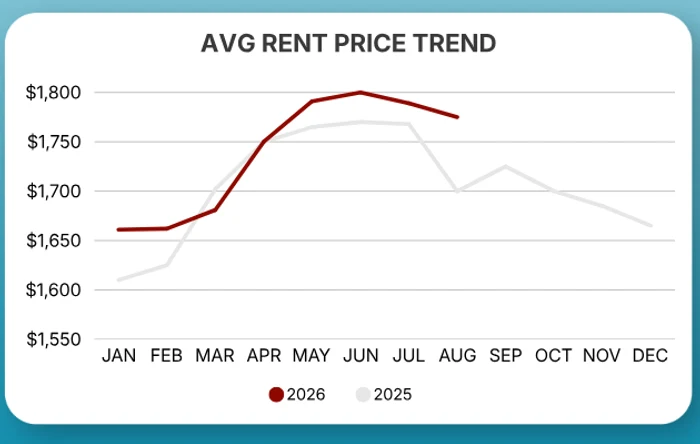
I've mentioned these three graphs here at the bottom. The bottom left one here is this average rent price trend, and the light gray is 2025, the red is 2026. So we are seeing very similar to 2025, but in May, we peaked up over last year's average price. So that's super encouraging.
Again, I already mentioned this, but average days on the market started off really high at about 70 at the beginning of the year, and it has quickly taken a nosedive for the better part to end up at about 45. Again, I want to see that get even lower as we get into June and July.
Based on previous years, I'm pretty sure that's what we should see here, still an improvement in the average days on the market.
And then this is the average homes on the market. This is just to kind of give you an idea of where the level of inventory is over time. It's kind of staying steady, which is good news.
It started off higher, which was strange to see that much excess inventory in January and February, but it has leveled off again, and we are seeing it on par, actually just a little bit down since last year. So overall, positive numbers to report for the Indianapolis rental market.
Chris Knight: This is great. In the graphs down there, at least from my perspective, what I use those average number of active homes trend for is how that relates to the average days on market trend.
If we are seeing year over year more active properties hit, are we seeing an increase in the average days on market? Are we seeing an impact to the average rent price trend? Because these are like the three staples, in my opinion, on how successful the market really is and what's trending.
To your point, this is amazing stuff that we're able to track year over year. Look at your average rent price trend, where we started $50 to $75 higher in January over last year, and then we kind of leveled out where we were last year. But it is following a very similar slope to where we were last year. That's awesome. I love to see those trends.
More importantly, we are trending higher in May's report than we were versus last year. In fact, we're up 1.47%, as Mike already indicated, which I think will probably level out a little bit. These increases are probably in direct relation to people paying higher taxes and higher insurance costs as real estate investors and trying to cover some of those costs.
So I just thought I'd throw in some of those keywords before we wrap up the Indianapolis market report. Mike?
Mike Taylor: Yeah. Actually, Chris, you bring up a good point about these three graphs at the bottom. You can honestly get an idea of how the market is and the three most important things.
Average rent, of course, that's super important. Days on the market, vacancy, what's my vacancy going to be? And then number of active homes. What's my competition?
You can look at those without anything and just get a really good quick glimpse of what's happening in the market.
Chris Knight: Bingo. These are your market staples, 100%. Okay. Let's get into some staples for the sales side, shall we?
Mike Taylor: Let's look at the sales data for Indianapolis for May. Again, we always look at this from an investor point of view. So we cap the purchase price at $500,000.
Most of our investors, if they're looking to invest in a home, are going to be below that, even far below $500,000. So that's why we cap it there.
Knowing that, the average sales price in Indy is super affordable: $257,611. Unbelievable when you look at that from a nationwide perspective.
Chris Knight: They're giving it away.
Mike Taylor: Seriously. If you're from California or Colorado, you're like, what is that? How do you get a house for that? And you get a decent house, a pretty good house for $257,000.
Month over month, that's up about 2%. Year over year, just basically about the same, a 0.32% increase on the average sales price.
Average days on the market, 49. That's okay. It's probably average of what we've been seeing. That's actually an improvement of 7.5% month over month, and then an increase year over year.
We saw a lot better days on the market last year, of course. The market seems to be a lot better last year than it was this year, although the bottom hasn't dropped out by any stretch of the imagination. Just a little bit of leveling off.
Number of homes sold is 1,084. That is up 17% month over month, which is pretty encouraging, down 2% year over year.
Average price per square foot for homes sold in Indianapolis under $500,000 is $167 per square foot. That is up just ever so slightly month over month and almost the same, 0.6% year over year.
We talked about the average sales price trend in the bottom left there. It's almost a mirror image of last year. So nothing honestly super exciting there, but in what is arguably a tough market, to see consistency with last year is pretty encouraging.
I think that's pretty encouraging. You're not seeing huge appreciation, but in other markets where you're seeing depreciation and sales prices are dropping, I think it's actually not too bad, given the condition of the market in the nation as a whole.
Number of homes sold, the bottom right graph there, just goes to show you at a quick glance where homes are selling in Indianapolis. We break that down by price point so you can see how much you have to pay to get into this market and how many homes are available as inventory in the different price ranges.
As you can see here, Indianapolis remains one of our more affordable markets that we report on. Actually, the vast majority of the homes are selling for under $200,000. There are almost 6,000 homes available under $250,000.
That's why I would encourage you to invest if you are thinking about investing in Indianapolis and want to get that balance of cash flow and appreciation. That's where I would target it. There is certainly lots of inventory available in Indianapolis. Again, just such a good, predictable, affordable market. I just love reporting on Indianapolis.
Chris Knight: Yeah, exactly. I don't have anything major to add here aside from some inside baseball, which I don't mind having those conversations right here on the podcast.
Why are we not adding a graph to these? We certainly have the room for it, for the average days on market trend year over year and the number of homes sold trend year over year. I'd love to see that, wouldn't you?
Mike Taylor: Oh yeah, I don't see why not. We've got the data. Might as well display it.
Chris Knight: I know. We'll talk more about that off camera.
The only other thing I wanted to add here is the number of homes sold. The sweet spot for Indianapolis, and I can't remember what you said, did you say between $250,000 and $300,000 or did you say $200,000 and $250,000?
Mike Taylor: I'm definitely under $250,000 if I'm an investor in Indianapolis, for sure.
Chris Knight: Agreed. That's exactly what I was thinking. The sweet spot as far as Indianapolis, now these other submarkets that we talk about, I find that the sweet spot is also in that range, maybe even a little over $250,000 in some of those areas for maximum appreciation play.
But as far as the Indianapolis metro market goes, yeah, $200,000 to $250,000. I think you can even find deals under the $200,000 price point. There are certainly enough of them there. So I think there are plenty of deals to be found in Indianapolis at an extremely affordable price.
But it is very important because we have a lot of investors, and let's talk about this for just a minute. Mike, indulge me for just a second, okay?
I've had probably three conversations in the last week with new investors where all three of them are looking for the exact same thing. They're looking for homes under $100,000, where they can add maybe $20,000 to it and then make $2,000 a month in monthly rent.
In my opinion, that is not really the right strategy because those homes that they're going to find, unless you find a diamond in the rough, and keep in mind you're not the only one looking for that diamond in the rough, are typically found in rougher areas, these D, D-minus areas that carry so much risk.
They pencil out on paper maybe, but in reality they tend to turn that real estate investor right back into a stock investor because it scares them right out of the market.
I've talked about this before on the podcast. I turn into my educational speech, which sometimes can turn people away from working with us, for better or worse. But I feel like that's necessary to have that educational speech with them, to keep them out of those areas and look closer to at least the $150,000, $175,000 price point as probably the bottom that I'm looking for, and then maybe a value-add.
That is going to be where you acquire a property that's going to appeal to the highest quality tenant, rent in the least amount of time, and reduce your turnover costs. That's the price point you should be looking for here in Indianapolis. Mike, what are your thoughts on that spiel?
Mike Taylor: I 100% agree. I get those texts and emails all day long about, hey, we've got this flip opportunity, this rehab opportunity. I feel like the market in Indy is the one that represents the riskiest ones.
I am 100% about value-add. I am 100% about doing a rehab and taking advantage of that. But you have to be careful in the area that you buy.
Just because it pencils out on paper, just because the wholesaler you've got says, hey, here's the ARV and here's the rent, that may be true once you get it rented, but the area that you're buying in probably represents some super high risk.
Again, you probably have vacancy, eviction costs, theft. You have to think about sometimes those areas have squatters, which adds to all of that. So what sometimes looks good on paper doesn't necessarily come to reality.
I think there are some better areas. Not to say that there are no value-add opportunities in Indy. I'm absolutely not saying that. What I'm saying is be careful in the areas that you choose to do that because I feel like there are more areas, especially kind of these wholesalers pushing these houses, that are dangerous and represent more risk.
For example, and I think you said this before, I would feel much better about encouraging somebody to do a value-add in Anderson or a secondary or tertiary market that represents a little bit less risk. So I think it's a great point.
Chris Knight: Bingo. Greenfield is a great area for something like that.
I just feel like Indianapolis, this is our market, right? I feel like it's worth spending a few minutes talking about those conversations that we're having. So there we are.
I'm going to clip this and send it to the next investor that tells me they're buying a property for $68,000 and they're going to drop $10,000 or $20,000 in and rent it for $2,000 a month.
All right, you ready for the next market? Okay. I'm going to pause right here.